

Table of Contents
- Introduction, They Are Everywhere and For Good Reason
- The Rise of Milwaukee - A Brief American History
- How Techtronic Industries Took Over
- Hong Kong, China, and Why the Line Is Blurry
- How Communism Took Hold and What Hong Kong Lost
- Where Your Money Actually Goes When You Buy Milwaukee
- The Marketing Machine That Built a Generation of Loyal Fans
- The Tools Are Good, That Part Is True
- But China Is Not Our Friend, And The Record Proves It
- FAQ
- Know What You Are Buying and Decide For Yourself
Introduction
Walk into almost any hardware store, any home improvement center, any job site supply house in America right now, and you are going to see red. Milwaukee Tools is everywhere. On the shelves, in the hands of tradespeople, in YouTube videos, in job site photos on Instagram. The brand has achieved a level of visibility and loyalty that most tool companies spend decades trying to build and never quite get there.
And here is the thing. The tools are good. Milwaukee did not build that presence by selling junk. Their M18 battery platform is genuinely excellent. Their product development has been aggressive and smart. If you own Milwaukee tools, you probably like them, and you are probably not wrong to.
But before you take that red tool at the register, there is something worth knowing. Something that does not show up on the packaging, does not come up in the reviews, and does not get mentioned in any of the very well-produced Milwaukee marketing you have been consuming: Milwaukee Tool is not an American company. And the story of who actually owns it, where it comes from, and what that means for where your money goes when you buy it, is worth understanding before you make your next purchase.
The Rise of Milwaukee
Milwaukee Tool has a legitimate American origin story, and it is honestly worth telling because it is part of why the brand loyalty runs so deep.
The company was founded in 1924 in Brookfield, Wisconsin, by A.F. Siebert. The original focus was on portable electric tools. Milwaukee built a strong reputation in the trades, particularly among electricians and plumbers, for making tools that held up under professional use. The Hole Hawg, introduced in 1949, became a legendary tool in the plumbing trade, and it is still made today. That kind of longevity is earned, not manufactured.
For decades, Milwaukee was a genuinely American company making tools that American tradespeople trusted. The brand built equity the old-fashioned way. Make something good, put it in the hands of the people who use tools for a living, and let the product speak for itself. It worked. Milwaukee became a name that meant something in the trades.
Then in 1995 Milwaukee Tool was acquired by Atlas Copco, a Swedish industrial company. That was the first ownership change that took the brand out of American hands. But Atlas Copco is a reputable European company with strong manufacturing standards; tool quality was maintained, and most people in the trades either did not notice or did not particularly care.
Then in 2005 Techtronic Industries acquired Milwaukee Tool from Atlas Copco. And that is where the story gets more complicated.
How Techtronic Industries Took Over
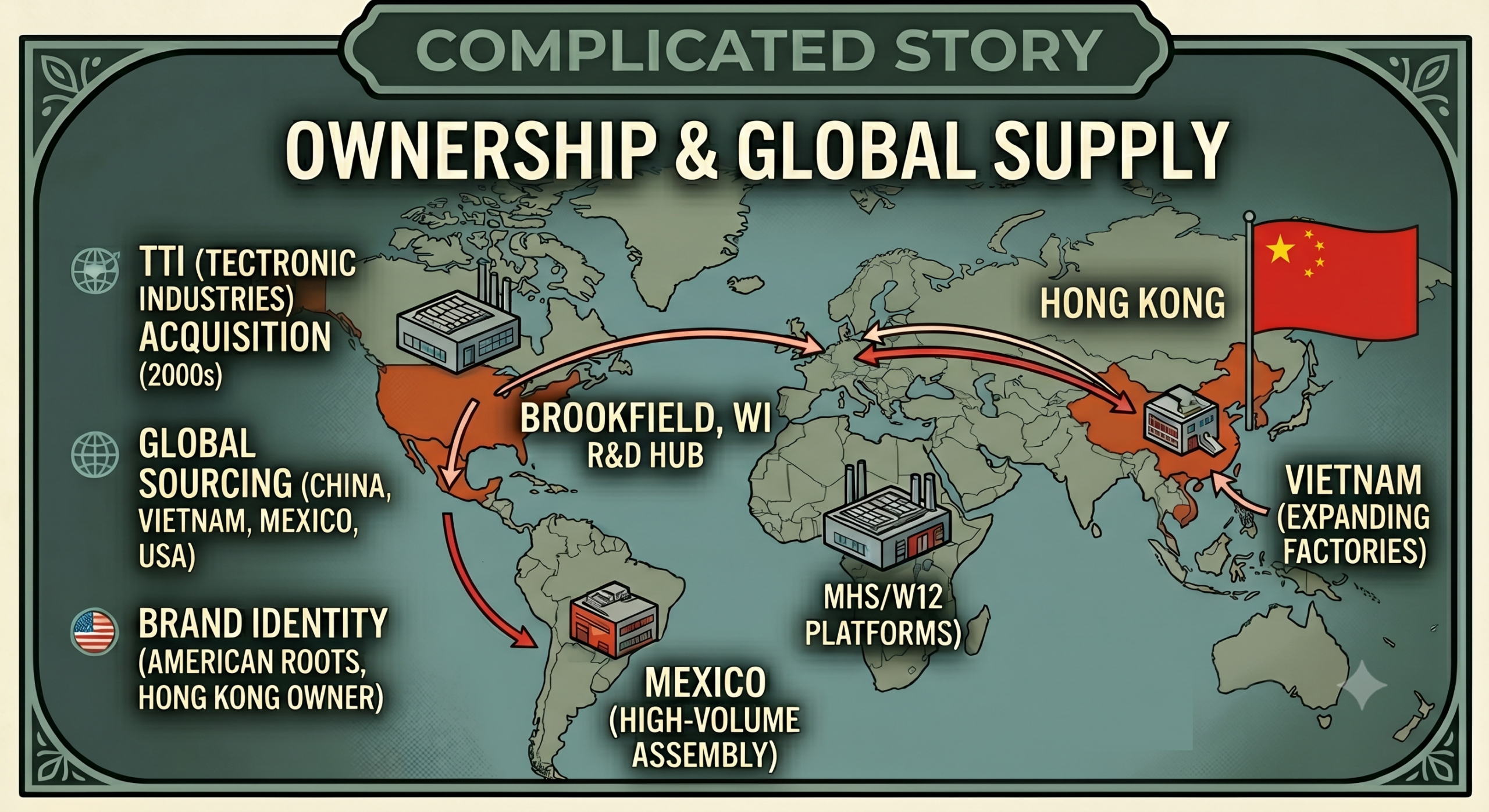
Techtronic Industries, known as TTI, is the company that owns Milwaukee Tool today. TTI also owns RYOBI, Hoover, Oreck, and several other brands you probably have in your house or garage right now. They are a major player in the global tool and appliance industry, and by most business measures they have been extraordinarily successful.
TTI is headquartered in Hong Kong. They are listed on the Hong Kong Stock Exchange. Their leadership, their corporate structure, and their primary business operations are based in Hong Kong.
Now TTI will point out, correctly, that they have significant manufacturing and operations in the United States. Milwaukee Tool has a campus in Milwaukee, Wisconsin. They do genuine product development and some manufacturing domestically. That is true, and it is worth acknowledging.
But here is what is also true. The profits generated by every Milwaukee tool sold flow back to a Hong Kong-based parent company. The shareholders of TTI, the people who benefit financially from Milwaukee's success in the American market, are overwhelmingly based in Hong Kong and broader Asia. When Milwaukee has a great quarter, TTI's stock price on the Hong Kong Stock Exchange goes up. That is just how corporate ownership works.
And in 2025, saying a company is based in Hong Kong and leaving it at that is telling only part of the story.
Hong Kong, China, and Why the Line Is Blurry
When Britain handed Hong Kong back to China in 1997 the arrangement was called One Country Two Systems. The idea was that Hong Kong would maintain its own legal system, its own economy, its own way of life for fifty years, until 2047. China promised the world and promised Hong Kong that the city's freedoms and its distinct identity would be preserved.
For a while that held reasonably well. Hong Kong was genuinely different from mainland China. Press freedom, rule of law, an independent judiciary, the ability to protest and speak freely. These were real and they mattered.
Then Beijing decided the arrangement was a little too loose for their comfort.
In 2020 Beijing imposed a sweeping National Security Law on Hong Kong that gave it broad new powers to punish critics and silence dissenters, which fundamentally altered life for Hong Kongers. The law was not debated by Hong Kong's legislature. It was not put to a vote by Hong Kong's people. It was imposed by Beijing and it took effect immediately.
Since the security law was enacted, at least nine hundred journalists have lost their jobs according to watchdog organization Reporters Without Borders. Jimmy Lai, founder of Apple Daily and a high profile pro-democracy advocate in Hong Kong, was detained by Chinese authorities in 2020 and sentenced to twenty years in prison in early 2026. Please check out this link and take time to read - Council on Foreign Relations
In March 2024, Hong Kong lawmakers passed Article 23, an expansion of the 2020 security law that broadens the definition of external interference and espionage, further cementing China's rule over the city's rights and freedoms.
The line between Hong Kong and mainland China is not as blurry as it used to be. It is getting clearer every year and it is moving in one direction.
How Communism Took Hold and What Hong Kong Lost
To understand what is happening in Hong Kong today, you have to understand how the Chinese Communist Party came to power and what it does with power once it has it.
The Chinese Communist Party, led by Mao Zedong, took control of mainland China in 1949 after a civil war against the Nationalist government. What followed was one of the most dramatic and brutal social transformations in human history. Private property was abolished. Religion was suppressed. Intellectuals, landowners, and anyone deemed a threat to the revolution were persecuted in waves of political campaigns. The Great Leap Forward in the late 1950s resulted in a famine that killed tens of millions of people. The Cultural Revolution from 1966 to 1976 destroyed cultural institutions, persecuted educated professionals, and tore Chinese society apart in the name of ideological purity.
Hong Kong, as a British colony, was a very different place through all of this. While mainland China was experiencing collectivization and political terror, Hong Kong was developing into one of the most dynamic free market economies in the world. It became a refuge for people fleeing the mainland, a financial hub, a place where capitalism and the rule of law produced genuine prosperity.
That contrast, a free and prosperous Hong Kong right next to a Communist mainland, was always a complicated situation for Beijing. And as China's economic power grew and its confidence grew with it, the tolerance for that contrast diminished. If you are interested, the story with Taiwan goes further on why China wants Taiwan back.
The National Security Law of 2020 was not a surprise to anyone paying attention. It was the logical conclusion of a Communist party that does not ultimately tolerate the kind of freedom that Hong Kong represented. The only question was timing.
Where Your Money Actually Goes When You Buy Milwaukee
This is the question that the Milwaukee marketing machine would prefer you not think too hard about.
When you buy a Milwaukee tool, a portion of that purchase price makes its way to TTI as profit. TTI is a publicly traded company on the Hong Kong Stock Exchange. Its largest shareholders are institutional investors based primarily in Hong Kong and broader Asia. The financial benefit of Milwaukee's extraordinary success in the American market flows to those shareholders.
Now TTI employs people in the United States. Milwaukee has American workers. That is real, and it matters. I am not suggesting that buying Milwaukee is equivalent to writing a check to the Chinese government. It is more complicated than that, and nuance is important here.
But it is also more complicated than buying from an American company. The corporate ownership structure, the shareholder base, the headquarters, the stock exchange listing- all of it points back to Hong Kong. And Hong Kong in 2025 is not the same place it was in 2005 when TTI acquired Milwaukee. The question of what relationship a major Hong Kong corporation has with the Chinese Communist Party government that now exercises significant control over Hong Kong is not an unreasonable one to ask.
You get to decide how much that matters to you. But you should at least be asking the question.
The Marketing Machine That Built a Generation of Loyal Fans
Here is where Milwaukee deserves genuine credit, and it is important to give it to them because this part of the story is actually impressive.
TTI took over Milwaukee in 2005 and made a strategic decision that changed everything. They were going to market Milwaukee like no tool company had ever been marketed before. They invested heavily in product development, in sponsorships, in getting tools into the hands of tradespeople and content creators, in building a brand identity that felt aspirational and professional and belonging to a tribe.
The One Key platform, the M18 ecosystem, the PACKOUT storage system, the aggressive expansion into new tool categories. These were not accidents. They were the result of a company that understood that in a crowded tool market, the brand experience is as important as the product itself. Maybe more important.
Milwaukee showed up everywhere tradespeople showed up. Job sites, trade shows, YouTube channels, Instagram feeds. They sponsored events and competitions. They built a community around the brand that made owning Milwaukee feel like being part of something. When was the last time you felt that way about a pair of pliers?
They also understood the battery platform game before most of their competitors did. Lock a professional into your battery ecosystem, and you have essentially locked them into your brand. Every new Milwaukee tool a tradesperson buys is justified in part because they already have the batteries. That is not an accident. That is a very smart business strategy executed very well.
Milwaukee's rise is a masterclass in brand building. It just happens to be a masterclass executed by a Hong Kong company using an American brand name as the vehicle.
The Tools Are Good, That Part Is True
This needs to be said clearly and honestly because credibility matters. Milwaukee makes genuinely excellent tools. Their M18 battery platform delivers real performance that professionals rely on every day. Their power tools, particularly in the categories they have focused on most heavily, are competitive with anything on the market. Their PACKOUT storage system is genuinely innovative and has set a standard that other companies are still trying to match.
If you are a professional electrician or plumber who has built your tool inventory around the Milwaukee M18 platform, you made a reasonable decision based on real product quality. Nobody is going to tell you that your tools are bad because they are not.
What we are saying is that the quality of the tools and the question of who owns the company are two separate conversations. A tool can be excellent and still be made by a company with a complicated ownership structure that raises legitimate questions about where your money goes. Both things can be true at the same time.
Milwaukee earned its reputation in the American trades over decades of delivering products that worked. TTI then took that reputation and poured rocket fuel on it with marketing and product development investment that accelerated the brand's growth dramatically. The result is a genuinely good product line wrapped in a very powerful brand story told by a Hong Kong company.
But China Is Not Our Friend, And The Record Proves It
So the tools are good. Acknowledged. Now let's talk about the country that ultimately sits behind the company that owns those tools, or who will own the tools in the future, because the record on China's behavior toward the United States is hard to just set aside when you are making a purchasing decision.
A Chinese national named Su Bin was found guilty of conspiring to steal sensitive military information, including the designs for the F-22 and F-35, for the Chinese military. By stealing terabytes of classified F-35 and F-22 data from US contractors, Beijing successfully bypassed decades of costly aerospace research. China's J-20 stealth fighter, which they proudly parade as a symbol of their military advancement, incorporates features from stolen American aviation files, including over 630,000 sensitive documents covering the F-22 and F-35 blueprints. They did not develop that capability. They stole it. From us. And then they pointed it back at us. The National Interest
In 2023, the Biden administration accused Chinese state-aligned actors of compromising Microsoft and gaining unauthorized access to the email accounts of senior US government personnel, including Commerce Secretary Gina Raimondo and the US ambassador to China. These are not random targets. These are the people making decisions about trade policy and diplomatic relationships with China. Getting into their emails is not curiosity. That is intelligence gathering aimed at giving China an advantage in every negotiation they have with us. FDD
In 2024, hackers linked to the Chinese government broke into parts of the US telecommunications system in a breach that may have been connected to an attempt to access data from the presidential campaigns of both Donald Trump and Kamala Harris. They were not picking sides. They were collecting everything. The Department of Justice indicted seven Chinese nationals associated with a hacking group that spent approximately 14 years targeting US and foreign critics, businesses, and political officials in support of China's economic espionage and foreign intelligence objectives. Global SecurityGlobal Security
Chinese state-sponsored cyberattacks targeting US infrastructure seek to disrupt military supply lines and hinder an effective US response in case of a potential conflict, especially over Taiwan. Read that again. They are already positioning themselves for a potential military conflict with the United States, and their preparation includes getting inside our infrastructure systems. The Soufan Center
I am not here to tell you that TTI is passing Milwaukee's quarterly earnings reports to the Communist Party. But let's not pretend the walls between Hong Kong business and Chinese government influence are as solid as they used to be. China has been methodically tightening its grip on Hong Kong politics, Hong Kong culture, and Hong Kong institutions for years. The National Security Law did not happen in a vacuum. It happened because Beijing decided that Hong Kong's independence was becoming inconvenient, and they moved to end it. That process is not finished. It is ongoing, and it is moving in one direction.
TTI is a Hong Kong company operating in an environment where Beijing's reach grows a little longer every year. Where business leaders who say the wrong thing face consequences. Where the line between what the Communist Party wants and what a Hong Kong corporation does is getting harder to see. Nobody can tell you with certainty what that relationship looks like behind closed doors. What we can tell you is that the country behind all of this, the one hacking our military secrets, breaching our telecommunications systems, targeting our politicians and our infrastructure, is not a neutral party. It is an adversary that has been playing a long game against American interests for decades while we bought their products and called it a good deal.
FAQ
The brand has American roots going back to 1924, and Milwaukee does have operations and product development happening in the United States. But the company is owned by Techtronic Industries, a corporation headquartered in Hong Kong and listed on the Hong Kong Stock Exchange. Whether you consider that American depends on how you define the term, but the profits flow to a Hong Kong-based parent company, and that is just the reality of the ownership structure.
Yes, and this is not a conspiracy theory. A Chinese national named Su Bin was convicted in US federal court of stealing over 630,000 sensitive military files, including designs for the F-22 and F-35. Intelligence officials and defense analysts widely believe China's J-20 stealth fighter incorporated elements from that stolen data. China bypassed decades of costly aerospace research and development by taking what American engineers and taxpayers spent billions creating.
Because it speaks to the character and the intentions of the government that now holds significant political influence over the city where Milwaukee's parent company is headquartered. You are not just buying a tool. You are participating in a financial relationship with a company operating inside an increasingly China-controlled environment. How much that matters is a personal decision, but it is one you should make with full information rather than none.
Know What You Are Buying and Decide For Yourself
Milwaukee Tool built something genuinely impressive. Starting from a legitimate American legacy, a Hong Kong-based company took over a respected brand, poured resources into product development and marketing, and created one of the most dominant tool brands in the world. The tools are real. The performance is real. The brand loyalty is real, and it was earned product by product over years of delivering for the trades.
None of that changes what is also true.
The money you spend on Milwaukee tools flows to a Hong Kong-based parent company operating in an environment where Chinese Communist Party influence grows a little stronger every year. The same government that stole our fighter jet designs, hacked our Treasury Department, breached our telecommunications systems, targeted our politicians, and has been systematically dismantling the freedoms of Hong Kong people one law at a time, that government is increasingly the dominant force in the city TTI calls home.
You are allowed to buy Milwaukee tools. Nobody is stopping you, and this article is not telling you that you are a bad person if you do. What this article is telling you is the story you were sold- that Milwaukee is just a hard-working tool brand built for the American trades- is incomplete. There is more to it, and you deserved to know the rest.
The trades are full of people who take pride in their work, in doing things right, in knowing what they are using and why. That same instinct that makes a good tradesperson great is the instinct that says you should know where your tools come from and who benefits when you buy them.
Klein has been making tools in America since 1857. Channellock has been making pliers in Pennsylvania since 1886. These companies do not have the marketing budget Milwaukee has. They do not have the shelf space Milwaukee has. What they have is a track record, an American address, and a pretty compelling answer to the question of where your money goes when you buy their products.
You get to decide what matters to you. Just decide with your eyes open.
Related TIA article: Why Where Your Tools Are Made Matters More Than You Think
