
Table of Contents
- Introduction
- What MULTI SEAL Is
- How It Seals a Puncture
- Formulas for Different Jobs
- Passenger Cars and TPMS
- Who It’s For
- Final Thoughts
- FAQ
Introduction
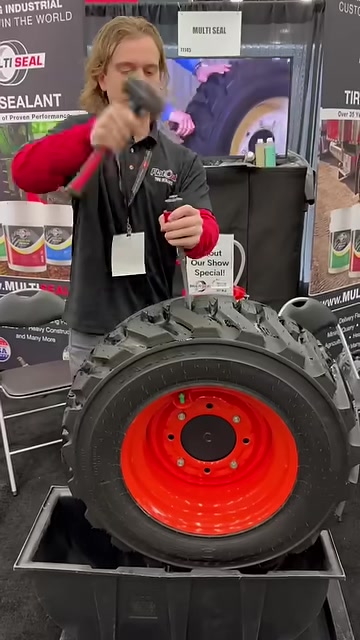
At a trade show, our editors stopped at the MULTI SEAL booth, where they were hammering spikes into a sealant-treated equipment tire and pulling them back out. The short clip racked up a huge number of views, so here’s what MULTI SEAL is, how it works and, just as important, what it’s not for.
Important: MULTI SEAL is an industrial and off-road tire sealant. The maker does not recommend it for passenger vehicles, including 1/2 ton trucks and SUVs, because it isn’t compatible with the TPMS sensors commonly used in passenger cars.
What MULTI SEAL Is
According to the maker, MULTI SEAL is its industrial line of tire sealants, aimed at industries such as waste, agriculture, mining, trucking, construction and the military. Its retail sister line, FlatOut, is designed for personal equipment such as riding mowers, zero-turns, trailers, ATVs, UTVs and golf carts.
How It Seals a Puncture
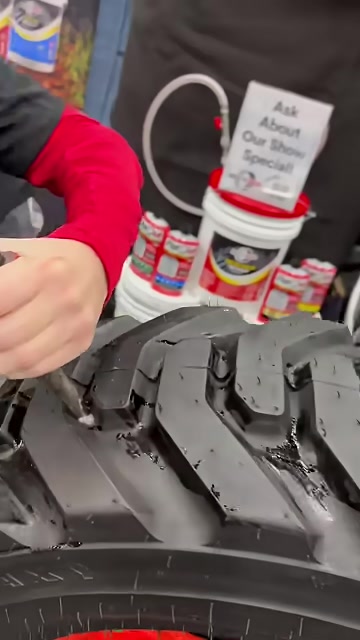
The maker describes it as synthetic fibers and fillers suspended in a liquid. When a tire is punctured, escaping air carries the sealant to the hole. The fibers catch on the sides of the puncture and trap the fillers, forming a plug. There’s no drying or curing; it’s a mechanical plug. That’s exactly what the clip shows: spikes driven in and pulled out of the tire.
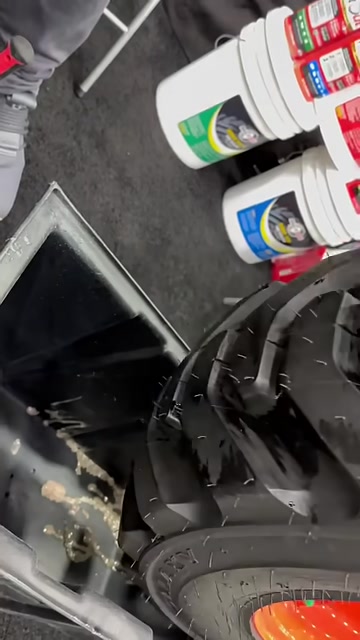
MULTI SEAL says it seals up to 95% of tread-area punctures in tubeless tires and up to 70% in tubed tires. The company is also clear that no sealant can make a tire flat-proof, and any punctured tire used at high speed should be inspected by a professional.
Formulas for Different Jobs
MULTI SEAL lists several industrial formulas: ARMOR 3500 for the most hazardous environments, rated for punctures up to 1-1/4 in. in tires of 18 plies or more; PRO HD 2500, its workhorse, for punctures up to 3/4 in.; and HYDRO 1500 for liquid-ballast-filled tires, for punctures up to 1/2 in.
Passenger Cars and TPMS
This is the big caveat. The maker says that while its sealant will seal punctures in passenger car tires, it does not recommend using it in passenger vehicles, including 1/2 ton trucks and SUVs, because it isn’t compatible with the valve-stem-mounted TPMS sensors commonly found in them. Some TPMS types, such as external screw-on sensors, are listed as compatible. If you’re unsure, check with the maker before you use it.
For speeds over 45 mph, the maker recommends its sealant only in vehicles of 3/4 ton payload or greater and in trailers, at the correct dose. Read more in MULTI SEAL’s FAQ.
Who It’s For
Equipment owners, farms, fleets and job sites running skid steers, tractors, trailers and other off-road tires. For more, browse our automotive product reviews.
Final Thoughts
The demo is impressive: spikes in, spikes out, and the tire keeps its air. Just use it where the maker intends, on industrial and off-road tires, and not in a passenger car with TPMS.
FAQ
Can I put MULTI SEAL in my car’s tires?
The maker does not recommend it for passenger vehicles, including 1/2 ton trucks and SUVs, because it isn’t compatible with the TPMS sensors commonly used in them.
What is MULTI SEAL made for?
Industrial and off-road tires in industries such as agriculture, construction, mining, waste and trucking. The maker’s FlatOut line is aimed at personal equipment like mowers, ATVs and trailers.
How does it seal a puncture?
Escaping air carries fibers and fillers to the hole, where they form a mechanical plug. Nothing has to dry or cure.
Will it make my tire flat-proof?
No. The maker says it greatly reduces flats but never claims a tire becomes flat-proof.
Does it work in tubed tires?
Yes, but the maker says it’s less effective: up to 70% of tread-area punctures in tubed tires versus up to 95% in tubeless.
Leave a Reply