

Table of Contents
- The World's Tool Factory Has a Problem
- How China Became the Default for Tool Manufacturing
- The Trade War That Changed the Calculation
- Where Are Brands Actually Moving Production?
- What "Made in Vietnam" or "Made in Mexico" Really Means
- The Long Game: Why Diversifying Away From China Makes Sense
- What This Means for Tool Prices and Availability
- FAQ
- Wrap-Up: A Shift That's Been a Long Time Coming
The World's Tool Factory Has a Problem
For the better part of three decades, the global tool industry ran on a simple formula: design it in America or Europe, build it in China, sell it everywhere. It was cheap, it was efficient, and it worked, until it didn't.
The cracks started showing before anyone wanted to admit it. Supply chain disruptions during COVID exposed just how dependent the tool industry had become on a single country for production. When Chinese factories shut down and shipping costs went through the roof, tool brands that had spent years consolidating their manufacturing in China had nowhere to turn. Shelves went empty, lead times stretched to absurd lengths, and brands that had always prided themselves on availability suddenly couldn't deliver.
But the supply chain chaos was just the most visible symptom of a deeper problem. Underneath it was a geopolitical reality that the business world had been quietly ignoring for years, that building your entire supply chain inside a country that has made no secret of its ambitions to challenge American economic and military dominance carries a risk that doesn't show up on a balance sheet until it suddenly does.
The tool industry is now in the middle of a slow but unmistakable reckoning with that reality. Brands are asking questions they weren't asking ten years ago. What happens to our production if tensions escalate further? What happens if tariffs go higher? What happens if access gets cut off entirely? The answers to those questions are driving some of the biggest manufacturing shifts the industry has seen in a generation.
How China Became the Default for Tool Manufacturing
It didn't happen overnight, and it didn't happen by accident. China's rise as the world's dominant tool manufacturing hub was the result of a deliberate combination of low labor costs, government subsidies, massive infrastructure investment, and trade policies that made it nearly impossible for brands to justify building anywhere else.
In the 1980s, most major tool brands still had significant domestic manufacturing operations. Stanley was building tools in New Britain, Connecticut, a city whose entire identity was wrapped up in tool manufacturing going back to the 1800s. Black & Decker had plants across the American South. Even smaller brands maintained regional production facilities that kept jobs close to home and supply chains short.
Then the economics shifted. Chinese labor costs were a fraction of American rates, the Chinese government was actively courting foreign manufacturers with tax incentives and subsidized industrial zones, and the infrastructure to support large-scale production, ports, roads, power, and logistics networks was being built out at a pace that no other developing country could match. When China entered the World Trade Organization in 2001, the last real barrier came down, and the floodgates opened.
By the mid-2000s, the migration was essentially complete for most of the industry. Brands that tried to hold out faced a brutal price disadvantage at retail. Consumers buying on price, and most consumers buy on price, gravitated toward the cheaper product on the shelf without thinking much about where it was made. The brands followed the math, and the math pointed to China.
What nobody fully accounted for was the dependency that came with it. Decades of offshoring didn't just move production; it moved knowledge, tooling, supplier relationships, and institutional expertise. Getting that back isn't as simple as building a new factory somewhere else and flipping a switch.
The Trade War That Changed the Calculation
For years, the business case for manufacturing in China was strong enough that most brands were willing to overlook the geopolitical risks. Then the tariffs hit, and the math started changing in real time.
The Trump administration's first round of tariffs on Chinese goods in 2018 sent shockwaves through the tool industry. Section 301 tariffs, which targeted a broad range of manufactured goods including power tools, added 25% to the cost of products being imported from China. For brands that had built their entire supply chain around Chinese production, that wasn't an abstract policy debate. It was an immediate hit to margins that had to go somewhere, either absorbed by the brand, passed on to the retailer, or eventually pushed down to the consumer at the register.
Stanley Black & Decker estimated at the time that the tariffs were costing the company hundreds of millions of dollars annually. Milwaukee, Makita, and virtually every other major brand with Chinese production faced the same pressure. Some absorbed what they could and raised prices on the rest. Some quietly accelerated conversations about moving production that had been sitting on the back burner for years.
What the tariffs did more than anything else was force a calculation that brands had been avoiding. When China was cheap enough, the geopolitical risk felt manageable, a theoretical problem for another day. When a 25% tariff landed on your income statement, that theoretical problem became very real very fast. Suddenly the cost of diversifying away from China didn't look so bad compared to the cost of staying.
The tariffs didn't disappear under the Biden administration either, most were kept in place, and the broader posture toward China as a strategic competitor hardened across both parties. When the second Trump administration came in and escalated tariffs further in 2025, any brand that hadn't already started moving was now seriously behind. The window for treating China as a consequence-free manufacturing base had closed, and the industry knew it.
Where Are Brands Actually Moving Production?
The short answer is: a lot of places, and none of them are a perfect replacement for China. That's the reality brands are navigating right now, there's no single country that can absorb what China built over three decades, so the strategy has shifted toward diversification rather than substitution.
Vietnam has been the biggest beneficiary of the manufacturing exodus so far. The country has been aggressively courting foreign manufacturers for years, offering low labor costs, a growing industrial infrastructure, and a government that has made attracting foreign production a national economic priority. Stanley Black & Decker has moved some of their manufacturing there. For lighter manufacturing, tools, accessories, and components that don't require the heaviest industrial equipment, Vietnam has proven it can deliver.
Mexico has become the other major destination, particularly for brands that want to shorten their supply chain to the United States and take advantage of USMCA trade benefits. Techtronic Industries (A Hong Kong Company), which owns Milwaukee and Ryobi, has been expanding its manufacturing footprint in the US and Mexico. DeWALT has invested in US-based assembly operations, including a facility in North Carolina that has been held up as a model for reshoring. These moves don't eliminate the China dependency entirely, but they reduce it and give brands more options when geopolitical pressure spikes.
India is a longer-term bet that several brands are starting to make. The labor cost advantage is significant, the government has been pushing hard to attract manufacturing investment, and the domestic market for tools is growing fast. Bosch has had a significant manufacturing presence in India for years and has been expanding it. The infrastructure isn't yet at the level of Vietnam or Mexico, but the trajectory is in the right direction.
What's notable is that almost every major brand is now talking about supply chain diversification in their investor communications, something that would have been a footnote five years ago. The direction of travel is clear. The question is just how fast they can execute it.
What "Made in Vietnam" or "Made in Mexico" Really Means
When a tool shows up on the shelf with a "Made in Vietnam" or "Made in Mexico" label, the natural assumption is that the brand has successfully moved production out of China. The reality is a little more complicated than that.
Manufacturing in the modern global economy is rarely a clean handoff from one country to another. A tool that's assembled in Vietnam may still have its motor wound in China, its battery cells produced in China, and its electronic components sourced from Chinese suppliers. The final assembly happens in Vietnam, which is where the country of origin label comes from, but the Chinese supply chain is still very much in the picture, just one step further back.
This practice, sometimes called "tariff engineering" or more bluntly "tariff washing," has become common enough that US Customs and Border Protection has cracked down on it in several industries. The rule of thumb is that a product needs to undergo substantial transformation in the country listed on the label, not just final assembly of Chinese-made parts. Some brands are doing this right, genuinely building out local supplier networks in their new manufacturing locations. Others are doing the minimum necessary to qualify for a different country of origin label while keeping the bulk of their Chinese supply chain intact.
The distinction matters because a tool that's genuinely manufactured in Vietnam or Mexico, with locally sourced components, local labor, and real investment in local production capacity, is a fundamentally different supply chain risk than one that's just bolted together there. The former actually reduces dependency on China. The latter mostly just changes the label.
It's worth asking, when a brand makes a big announcement about moving production, exactly what is moving. Assembly operations are the easiest thing to shift. Component manufacturing and raw material sourcing are where the real dependency lives and that's a much harder thing to move quickly.
The Long Game: Why Diversifying Away From China Makes Sense
Setting aside the tariffs and the supply chain disruptions for a moment, there's a bigger picture worth looking at. China has been an extraordinarily capable manufacturing partner for the global tool industry. The infrastructure, the workforce, the supplier networks, all of it is genuinely impressive. But a business relationship and a geopolitical relationship are two different things, and conflating them has been one of the more expensive mistakes Western companies have made over the past 30 years.
China has made its strategic ambitions clear and hasn't been particularly subtle about it. The military buildup, the posture toward Taiwan, the Belt and Road Initiative designed to extend economic influence across developing nations, the technology transfer requirements that have cost Western companies billions in intellectual property, these aren't fringe concerns raised by political commentators. They're documented policy positions of the Chinese government that have real implications for any company that has made itself dependent on Chinese production.
For tool brands specifically, the IP risk has been a quiet but persistent problem. Designs that get manufactured in China have a way of showing up in the market under different brand names at a fraction of the price. The mechanisms for protecting intellectual property in China exist on paper, but enforcing them is another matter entirely. Brands that have built their competitive advantage on engineering innovation have good reasons beyond tariffs to want more distance between their designs and Chinese contract manufacturers.
The diversification happening right now in the tool industry isn't just a reaction to tariffs or a supply chain lesson from COVID. For the brands thinking clearly about the next 20 years, it's a recognition that building critical manufacturing dependency inside a country with fundamentally different interests than your own is a strategic risk that compounds over time. Getting out isn't fast or cheap, but the alternative, waiting until the risk becomes a crisis, is worse.
The brands moving production now, even at short-term cost, are making a bet that looks increasingly like the right one.
What This Means for Tool Prices and Availability
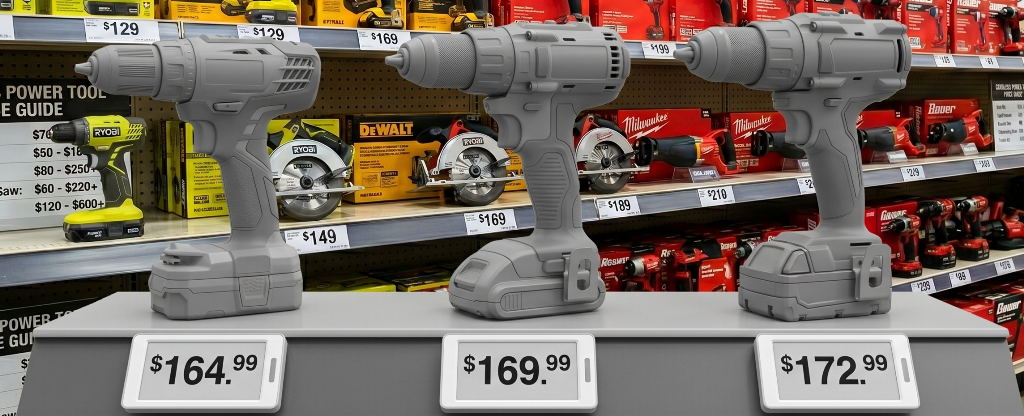
If you've noticed tool prices creeping up over the past few years, supply chain restructuring is a big part of why. And if the trends continue and there's no real reason to think they won't, that pressure on pricing isn't going away anytime soon.
The economics are straightforward. China built a manufacturing cost structure over 30 years that no other country can match right now. Labor is cheaper in Vietnam and India, but the supplier networks, the tooling expertise, and the sheer scale of Chinese industrial capacity took decades to build and can't be replicated quickly. When brands move production to Vietnam or Mexico, they're accepting higher per-unit costs in exchange for supply chain security. That cost has to go somewhere.
DeWALT, Milwaukee, and Stanley Black & Decker have all implemented price increases over the past several years, citing raw material costs, logistics, and supply chain restructuring as primary drivers. Some of those increases have been modest, a few dollars on a drill, a few more on a larger kit. Others have been more significant, particularly on professional-grade platforms where the component complexity is higher and the supply chain transition is harder.
Availability has been the other casualty. Brands that are in the middle of transitioning production, winding down Chinese capacity while building up operations elsewhere, go through a period where neither location is running at full efficiency. That's when you see stock shortages, extended lead times, and the frustrating experience of a tool being listed as available online but backordered at every retailer that actually carries it.
The long-term picture is more optimistic. Once the supply chain restructuring settles and new production locations reach full capacity, the cost and availability situation should stabilize. But "long term" in manufacturing means years, not months. In the near term, expect prices to stay elevated and availability to remain uneven, especially on the product lines that are deepest in the middle of a production transition.
FAQ
A combination of factors that have been building for years: tariffs, trade tensions, supply chain vulnerabilities exposed by COVID, and a growing recognition that concentrating all your manufacturing in a single country with its own strategic agenda carries real long-term risk. The brands that saw this coming early are in a much better position today than the ones that waited.
Yes, by a significant margin. Despite the momentum toward diversification, China still produces the majority of the world's power tools. That won't change overnight. What's changing is the trajectory, brands are actively reducing their Chinese dependency, and the share is moving in one direction even if it's moving slowly.
That's a question the industry is answering with its feet. The intellectual property risks, the geopolitical tensions, the tariff exposure, and the supply chain fragility all point in the same direction. A country that has made clear it operates on its own strategic interests, not yours is a risky place to anchor your entire production capability. The brands thinking 20 years out are treating diversification as a necessity, not an option.
Wrap-Up: A Shift That's Been a Long Time Coming
The global tool industry didn't end up this dependent on China by accident, and it's not going to untangle itself from that dependency quickly. But the direction is clear, the pressure is real, and the brands that treat this moment as a wake-up call rather than a temporary inconvenience are the ones that will be better positioned on the other side of it.
What's happening right now is bigger than tariffs. Tariffs were the trigger, but the underlying issue is that the business world spent 30 years optimizing for the cheapest possible production without fully accounting for what it meant to hand that much leverage to a country operating on its own terms. The tool industry is one of dozens of industries now reckoning with that decision.
The good news for contractors and tradespeople is that more domestic and nearshore production ultimately means shorter supply chains, faster response to demand, and less exposure to the kind of disruptions that emptied shelves during COVID. It may cost more in the short term, but a supply chain that actually works when things get difficult is worth paying for.
And there's something worth saying plainly. Moving production out of China isn't just a smart business decision, for American brands, it's increasingly the right one. A manufacturing base that isn't hostage to the decisions of a government with different values and different interests is a more resilient, more trustworthy foundation to build on. The brands making that move now, even at real cost, deserve some credit for playing the long game.
The China Factor isn't going away. But its grip on the tool industry is loosening.
