
Archived from the Tools In Action forum (Power Tools). This thread is read-only.
Just saw this on the HD site and I’m in the market for a nice little heater for the shop. Has any of the crew ever used one, and if so how do you like. I value you guys opinions more then what they post in their item reviews.
Model # RCP502S Internet # 202909808 Store SO SKU # 1000538041
The durable Cadet 5000-Watt Garage Heater requires a NEMA #6-30 240-volt receptacle (not a standard 120-volt outlet) to provide your garage or workshop with powerful warmth on cold days. It features two heat setting positions for versatility in either low or high wattages. It also offers a built-in fan-only switch that provides comfortable air circulation without producing heat during the summer months.
6 ft. cord with polarized plug requires NEMA #6-30 240-volt receptacle; a standard 120-volt outlet will not work to power this heater
5000-watt premium utility heater at 240 volts provides warmth for large, hard-to-heat areas like garages and workshops
Rugged 20-gauge steel construction with a baked-on powder-coat paint finish for long-lasting wear
Built-in fan-only switch provides comfortable air circulation without heat
2-pole thermostatic control offers positive off position
High-temperature safety feature turns heater off if normal operating temperature is exceeded
Factory equipped with a bracket for either wall mount or floor stand use
20-gauge steel construction with a baked-on powder-coat paint finish for long-lasting wear
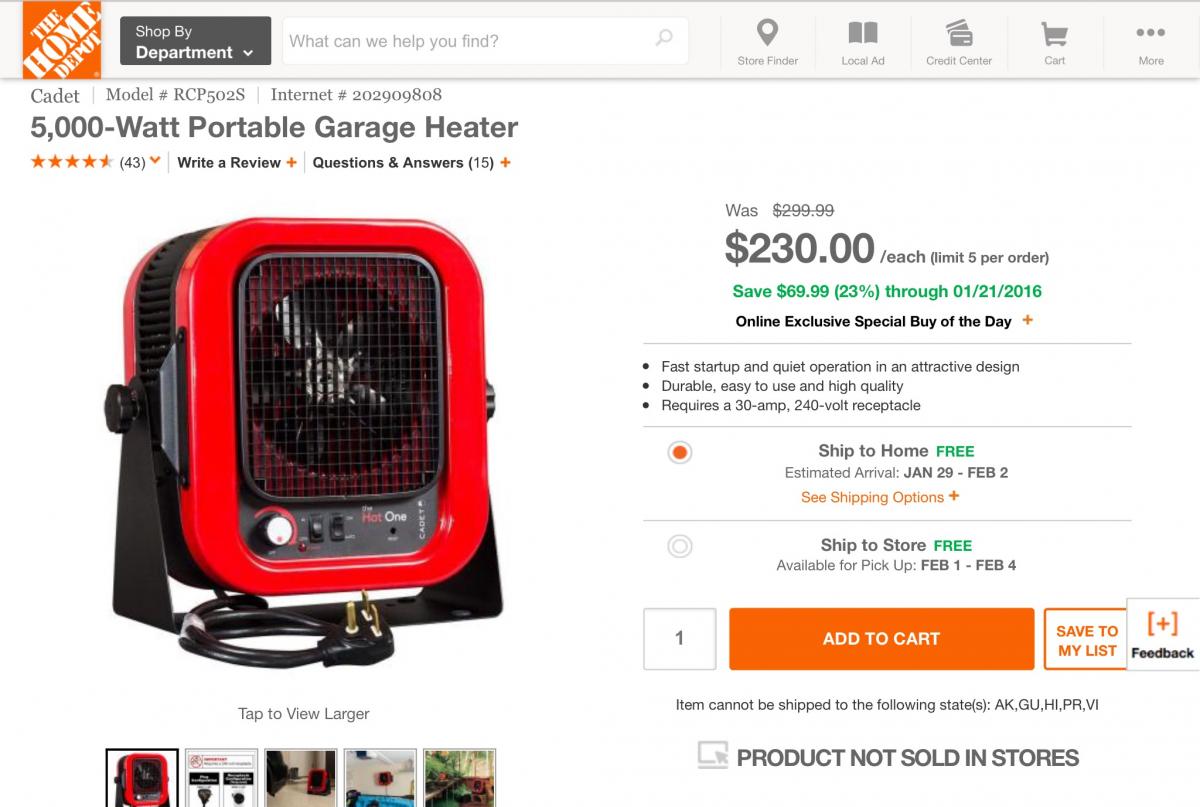
Im looking for one to curious what guys say
Sent from my iPhone using Tapatalk
Sounds like it would cost a ton to run, I have quartz heater I use and it is nice and only costs like 40 a month running all the time
Sent from my Nexus 6 using Tapatalk
I would stay away from electric heat it’s just so energy inefficient for the most part and so expensive. I would get a propane heater and use 100 lb propane tank or 2 smaller ones tied together. Another option is a wood burning pellet stove. It all depends on how often your going to run heat and how insulated the garage is.
I was thinking just a little supplement heat in the basement shop. I have gas boiler, radiator heat and I insulated the pipes so well, very little heat is transferred in the space. On cold days the floor gets really cold. I too agree electric heat is very inefficient and extremely expensive, this being a 240v system, I thought it might be cheaper to run, then again it could be a whole lot more. That’s why I was asking.
John, Sent from my iPad using Tapatalk
Think about the amount of energy your electric clothes dryer consumes (if you have one) it’s gonna be about the same, if you keep track of that sort of thing.
As far as working to get heat where you want it, no doubt it would work perfectly fine, I see similar heaters at a lot of places
Sent from my SCH-I535 using Tapatalk
Yeah I got rid of that energy hog last year and ran a gas line and installed a high efficacy model. Of course it freed up a 40amp 220v circuit, lol.KnarlyCarl wrote:
Think about the amount of energy your electric clothes dryer consumes (if you have one) it’s gonna be about the same, if you keep track of that sort of thing.
As far as working to get heat where you want it, no doubt it would work perfectly fine, I see similar heaters at a lot of places
Sent from my SCH-I535 using Tapatalk
Electric heat is horribly inefficient and one tgat size will be noticeable on your electric bill. Like Jason said it all depends on your total use but I would put electric heat at the bottom. I think that one of those torpedo heaters like Dan has that runs on propane, kerosene, diesel, ect. Is a better option. I think that wood heat is the best for a garage if you use it pretty often. We have a barrel stove in my dads shop at home and it works great for the size of our shop.Jasonc wrote:
I would stay away from electric heat it’s just so energy inefficient for the most part and so expensive. I would get a propane heater and use 100 lb propane tank or 2 smaller ones tied together. Another option is a wood burning pellet stove. It all depends on how often your going to run heat and how insulated the garage is.
Ok nice I did that to my electric range and stove, switched to gas, now I’m looking at doing the dryer too.
Sent from my SCH-I535 using Tapatalk
NicholasShetley wrote:
Electric heat is horribly inefficient and one tgat size will be noticeable on your electric bill. Like Jason said it all depends on your total use but I would put electric heat at the bottom. I think that one of those torpedo heaters like Dan has that runs on propane, kerosene, diesel, ect. Is a better option. I think that wood heat is the best for a garage if you use it pretty often. We have a barrel stove in my dads shop at home and it works great for the size of our shop.
I kinda like the idea of a motor oil furnace the only thing is having a steady supply of enough used oil and other combustibles to burn. You have to be an auto shop to justify it, or do a ton of side mechanics work. Haha never mind just looked at the prices ouch!!
Yeah I used to sell EnergyLogic brandJasonc wrote:
I kinda like the idea of a motor oil furnace the only thing is having a steady supply of enough used oil and other combustibles to burn. You have to be an auto shop to justify it, or do a ton of side mechanics work. Haha never mind just looked at the prices ouch!!
Sent from my SCH-I535 using Tapatalk
For a big truck or equipment they would be great since they hold so much oil. We had some big freightliners and international trucks at the electric cooperative over the summer that would hold over 40 quarts. It wouldn’t take to many oil changes with them to fill up the heater. Another thing is that they are super sensitive to other things in the oil such as antifreeze. It doesn’t take much at all to really screw with one.Jasonc wrote:
I kinda like the idea of a motor oil furnace the only thing is having a steady supply of enough used oil and other combustibles to burn. You have to be an auto shop to justify it, or do a ton of side mechanics work. Haha never mind just looked at the prices ouch!!
Take some of the insulation off of the boiler pipes, eliminate drafts in the basement. Or plumb an additional heat exchanger down there. Bam problem solved
Also just because it runs on 220 doesn’t make it more efficient in anyway. That’s a total myth. The electric company charges you for KW hours not amps
Of course! I vote for this idea, but that’s because I’m a pipe huggerRenner_construction wrote:
Take some of the insulation off of the boiler pipes, eliminate drafts in the basement. Or plumb an additional heat exchanger down there. Bam problem solved
Sent from my SCH-I535 using Tapatalk
Damn right! Why the hell not, it’s already down there doing its thing!
Sent from my iPhone using Tapatalk
A heaters purpose is to be 100 % in-efficient, just dumping everything into heat. So yeah, can’t get any worse.Renner_construction wrote:
Also just because it runs on 220 doesn’t make it more efficient in anyway. That’s a total myth. The electric company charges you for KW hours not amps
But you get a little tad smaller loss in the cabling, becouse lower amps means more of power reaches the unit. And gives better efficiency. But the losses in cabling is so low, it tops out a percent or so.
In other more advanced systems with power supplies and transformers, you usually save a percent or two in the unit itself by using 230V vs 115v. Less losses in windings and stuff. 🙂
I have no idea how you americans survive with 115V @ 20A breakers. Thats like… 2300 Watts. You must be tripping thoose breakers as a daily routine. And here I am thinking 230V @ 16A is too low.
Even my computer peaks out at more. 😛
And wondering if I need the full 3-phase 400V for the garage.
Yeah I don’t know how we Americans survive either, would love to have 3-phase 440v. Power comp. would love me to have that too I’m sure. ;( as a residential customer.
John, Sent from my iPad using Tapatalk
Andrull wrote:
A heaters purpose is to be 100 % in-efficient, just dumping everything into heat. So yeah, can’t get any worse.
But you get a little tad smaller loss in the cabling, becouse lower amps means more of power reaches the unit. And gives better efficiency. But the losses in cabling is so low, it tops out a percent or so.
In other more advanced systems with power supplies and transformers, you usually save a percent or two in the unit itself by using 230V vs 115v. Less losses in windings and stuff. 🙂
I have no idea how you americans survive with 115V @ 20A breakers. Thats like… 2300 Watts. You must be tripping thoose breakers as a daily routine. And here I am thinking 230V @ 16A is too low.
Even my computer peaks out at more. 😛
And wondering if I need the full 3-phase 400V for the garage.
Most breakers aren’t even 20A, just a measly 15A, and I can tell you it’s terrible. It’s actually amazing how many tools are designed specifically around getting the most effective power possible out of a 12VAC 15A plug. At the rate batteries are going, some of the higher voltage ones can probably already source a higher power than our wall outlets.
That said, it’s not so much higher current and voltage I wish for as three phase. The efficiency jump and constant power instead of pulsed would make a huge improvement for heavy tools.