
Disclosure: SharkBite sponsors the Tools In Action channel. Our opinions are our own.
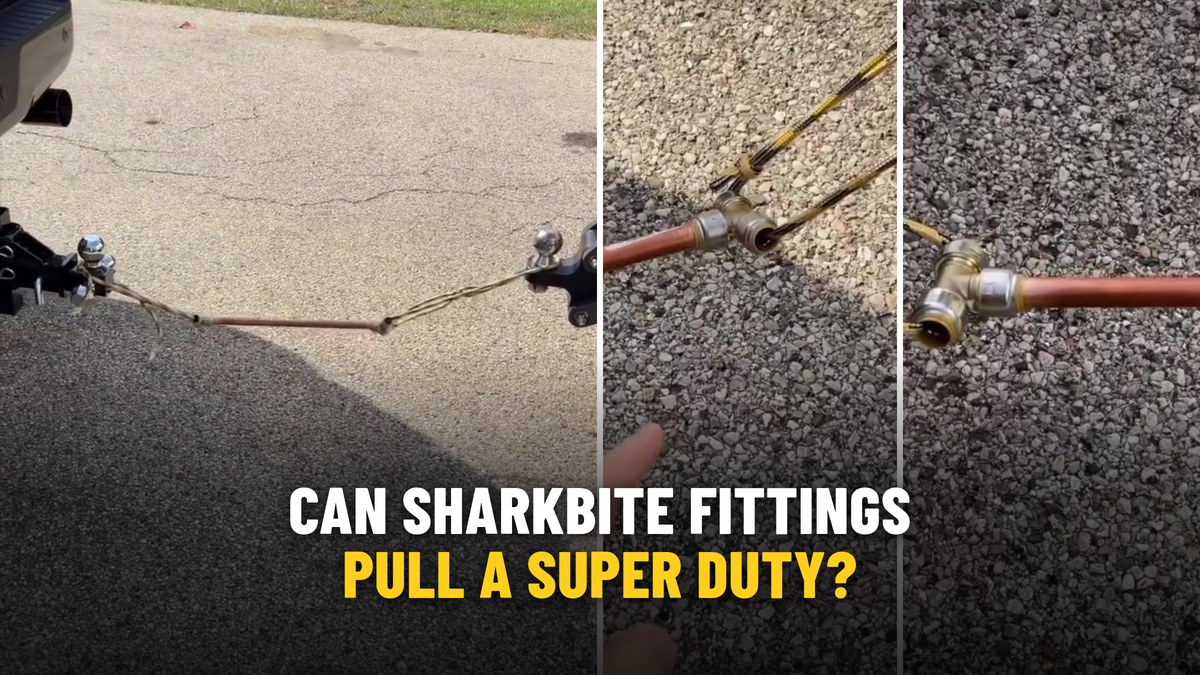
After our bucket of bricks test, people still had doubts about SharkBite fittings, so we went bigger. In this reel we put SharkBite push-to-connect fittings into the line between two pickups and pulled. Our caption asked the question directly: “How strong are Shark Bite Fittings? Can they pull a 10,000 lb Super Duty?”
What It Is
SharkBite push-to-connect fittings join pipe without solder, glue or crimping. Push the pipe in, and the fitting’s internal grip and seal do the work. SharkBite’s current generation is SharkBite Max. SharkBite says Max has a newly designed stainless-steel retainer that adds strength and double the pressure rating of the first generation. SharkBite also says Max works with copper, PEX, CPVC, PE-RT and HDPE SDR-9 pipe.
We put SharkBite push-to-connect fittings into the tow line for this test.
What the Video Shows
The line between the two trucks’ hitches includes SharkBite fittings. The pull starts with a little slack. Then the line comes tight, and everything is under load.
Then the trucks roll. On camera you can see the load come onto the line and both trucks moving. After the stop, we check the connections. The SharkBites held.
As we say at the end of the video, we just pulled a Super Duty with an F-150.
Takeaways From the Video
What stood out:
- The push-to-connect joints stayed together under a real towing load, which is far more than any fitting sees inside a wall.
- Installing the fittings took nothing more than pushing them on. There was no torch and no special tool.
- This lines up with what we saw in our bucket of bricks test. When the pipe is prepped right, the grip on these fittings is serious.
Things to keep in mind:
- This is a fun pull-apart demo, not a plumbing rating. Don’t use plumbing fittings as tow gear. Use rated tow straps and hardware for towing.
- A pull test shows grip. It doesn’t replace pressure and temperature ratings. Check SharkBite’s published specs for the fitting you’re buying. For SharkBite Max, SharkBite lists a temperature range of 34°F to 200°F.
- Installation is everything. Cut the pipe square, deburr it, clean it and mark the insertion depth so the pipe goes all the way to the tube stop.
Why Prep Matters More Than Anything
The number one reason people say SharkBite fittings “don’t work” is installation. A burr left on a cut pipe can damage the O-ring. A pipe that isn’t pushed in to the full depth makes only a partial seal. SharkBite’s own guidance is to cut square, deburr, clean and mark the insertion depth before you push the fitting on. SharkBite sells a SharkBite Max Depth & Deburr Tool for exactly that job.
If you do those steps, you get a connection that, as this video shows, takes a lot more than a tug to pull apart.
Who It’s For
If you’ve ever doubted push-to-connect fittings, this one’s for you. Homeowners doing a quick repair can see why SharkBite has the reputation it does with DIYers. Pros who have only seen SharkBites on a callback can see how much grip a properly installed fitting has.
SharkBite says SharkBite Max fittings can be used behind the wall without access panels and carry a 25-year warranty when properly installed with PEX, copper, CPVC and PE-RT pipe. That’s the kind of confidence that backs up a test like this.
Watch the reel above and let us know: what should we try pulling next?
Where to buy: SharkBite Max push-to-connect fittings
Leave a Reply