
Disclosure: SharkBite sponsors the Tools In Action channel. Our opinions are our own.
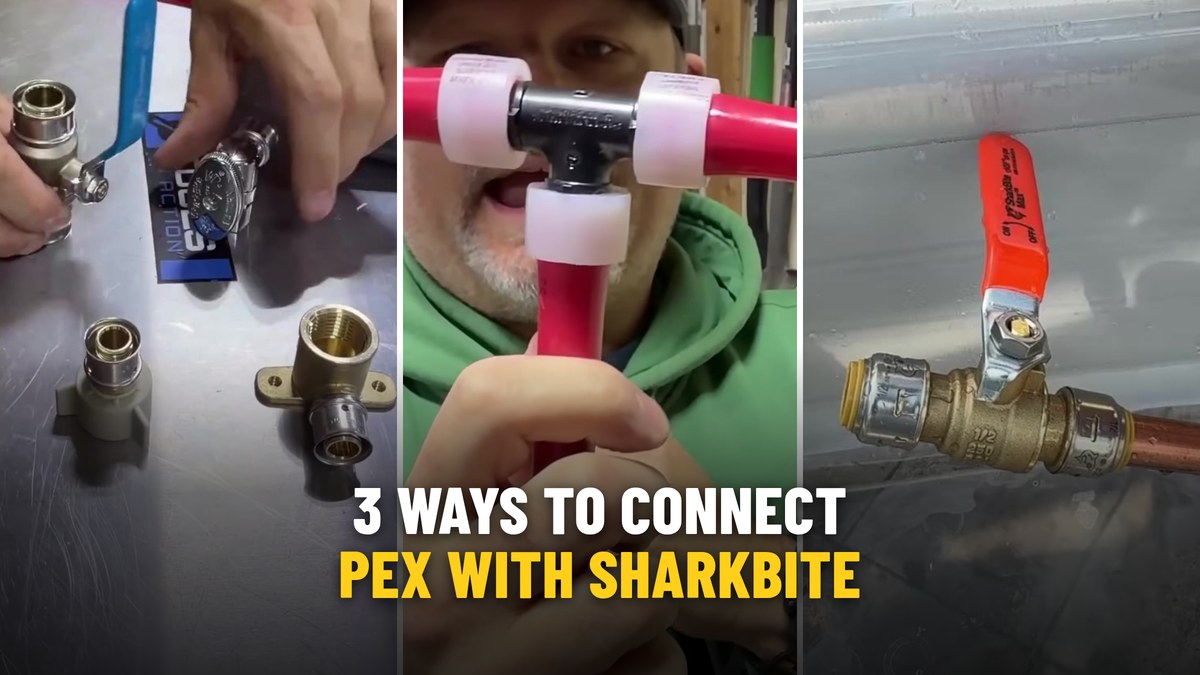
Plumbing is one of our favorite trades, because there are so many cool tools and connection methods. PEX is one of the easiest ways to install plumbing, and SharkBite makes fittings for three different ways to connect it. In this reel we run through all three: press, expansion, and SharkBite’s classic push-to-connect.
Connection 1: PEX Press
What it is: SharkBite PEX Press fittings for PEX-a and PEX-b pipe. Each one has a pre-attached stainless-steel sleeve, three viewing windows to confirm the pipe is fully inserted, and a built-in locator ridge for the tool. Those details come from SharkBite’s PEX Press brochure. The on-screen label in the video calls it a “permanent connection.”
What the video shows: The first thing you notice is that the rings don’t come off. Slide the PEX in, and as soon as you see red through the windows, you know the pipe is seated. The guides help you place the press tool, and one press gives you a clean, professional crimp. We point out that PEX Press comes in all different sizes and styles, including end caps.
Connection 2: Expansion
What it is: Expansion joins PEX-A pipe. You expand the pipe end with an expansion tool, insert the fitting, and the pipe shrinks back down onto it. On sharkbite.com, SharkBite describes its expansion line as F1960 brass and poly fittings for joining PEX-a pipe.
What the video shows: We use an expansion tool to open up the pipe. It stays expanded long enough for us to push the fitting all the way in. Right after it goes in, the fitting still feels a little loose. Over time the pipe tightens down on the fitting, and you get a leak-proof connection. This one uses a plastic (poly) fitting.
Connection 3: Push-to-Connect (SharkBite Max)
What it is: The typical SharkBite. In the video we show SharkBite Max fittings. SharkBite says Max fittings work with copper, PEX, CPVC, PE-RT and HDPE SDR-9 pipe, don’t need a tube liner for PEX, can be used behind the wall without access panels, and carry a 25-year warranty when properly installed with PEX, copper, CPVC and PE-RT pipe. SharkBite also says they can be removed with a disconnect clip, tongs or its pro disconnect tool. That’s why the on-screen label in the video reads “permanent or reusable connection.”
What the video shows: This one is our favorite. As we say in the video, these fittings don’t leak if you put them on properly. Sand the pipe, measure and mark your depth, and push. You might wonder why we’re showing copper in a PEX video. It’s because the same fitting connects right into PEX, too. We push it together and try to pull it apart. It won’t budge.
Takeaways From the Video
Which one should you use?
- Press: Fast and consistent, with visual confirmation. You need a press tool, either a battery tool or SharkBite’s PEX Press hand tool. It works on PEX-a and PEX-b.
- Expansion: A common choice for PEX-A installs. You need an expansion tool and the right sleeves, and the connection tightens as the pipe recovers.
- Push-to-connect: No tools needed to make the connection, it can be removed, and it’s the easy way to go from copper to PEX. Prep is critical: deburr, clean and mark the depth.
Things to keep in mind:
- Match the fitting to your pipe. Expansion is for PEX-A, PEX Press is for PEX-a and PEX-b, and push-to-connect covers the widest range of pipe types.
- Always follow local code. Some areas restrict where PEX can be used.
- Whichever method you pick, a square, clean cut is where every good connection starts.
Who It’s For
This video is for anybody getting into PEX. That includes the DIYer deciding which system to buy into and the pro who wants to see how SharkBite’s three methods compare side by side. You don’t have to pick just one. Plenty of plumbers use press or expansion for new runs and keep push-to-connect fittings on hand for repairs and transitions.
Watch the reel above and tell us which connection is your favorite.
Where to buy: SharkBite PEX Press fittings | SharkBite PEX-A expansion fittings | SharkBite Max push-to-connect fittings
Leave a Reply