
Disclosure: SharkBite sponsors the Tools In Action channel. Our opinions are our own.
Most SharkBite videos you’ll see are DIY repairs. This one is a working pro job. We went out with Bill, a local plumber, in Kenosha, Wisconsin, where his crew is doing lead line abatement and moving water meters, and he’s using a lot of SharkBite to do it. We asked him why.
What It Is
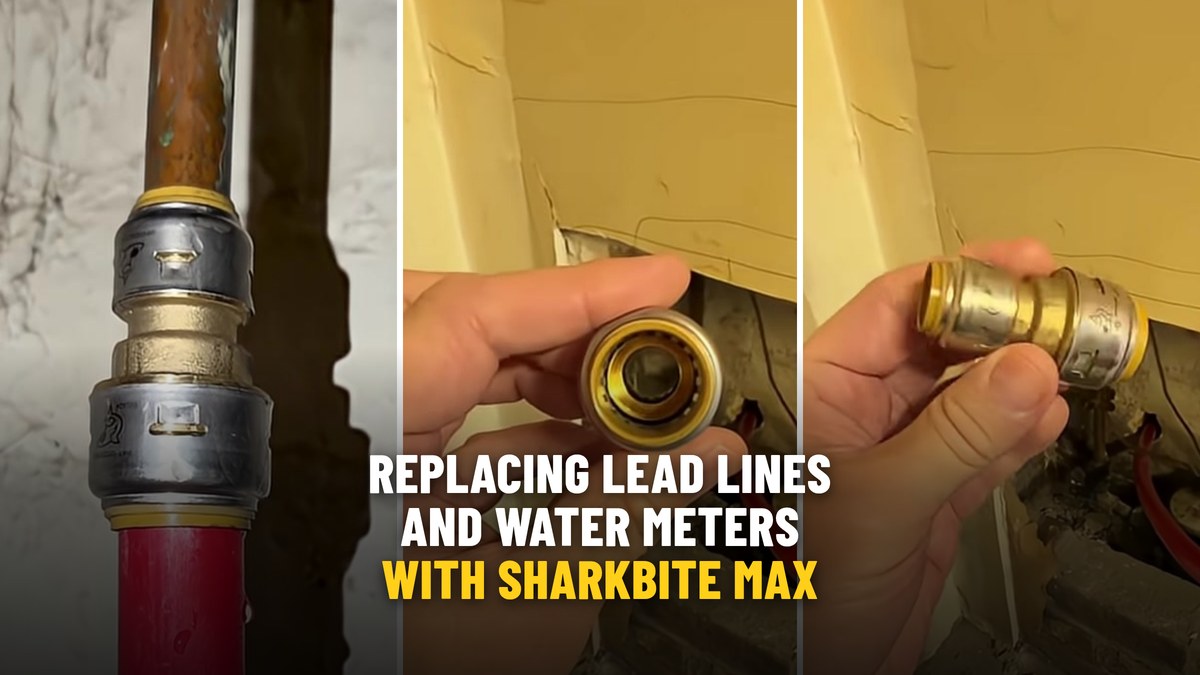
The key part in this video is a SharkBite Max push-to-connect fitting. SharkBite Max is SharkBite’s current generation of push-to-connect fittings. On sharkbite.com, SharkBite says Max:
- Has a newly designed stainless-steel retainer for additional strength.
- Is compatible with copper, PEX, CPVC, PE-RT and HDPE SDR-9 pipe.
- Doesn’t need a tube liner for PEX.
- Can be used behind the wall without access panels.
- Carries a 25-year warranty when properly installed with PEX, copper, CPVC and PE-RT pipe.
On this job, the Max fitting transitions from 3/4 in. PEX to 1/2 in. copper.
What the Video Shows
When we ask Bill why he uses SharkBite, his answer is short: “They’ve held up the test of time.” He calls it a very strong, durable product that he can stand behind and feels comfortable putting in people’s houses.
Here’s the job. At this house, the old water meter has to come out and be replaced with a new smart meter in a new location at the front of the house. As we explain in the video, that’s where code now says it has to be. The crew drills through to the new spot and runs new PEX to it.
Usually they would run the line through the ceiling, but on this house they can’t. Instead they run it along a wall, and the homeowner plans to box it in later.
Then we show the key connection. Where the new PEX run meets the existing plumbing by the meter, a SharkBite Max fitting makes the transition from the 3/4 in. PEX to the 1/2 in. copper. They cut the old meter out, make the connection, and that’s it.
Bill has been doing this for many years with SharkBite and says he’s never had a leak, as long as you put it on properly. Our TikTok caption adds that his company has installed hundreds of these with zero issues.
Takeaways From the Video
What stood out:
- This is a pro plumbing crew choosing SharkBite on a code-driven job, not just a homeowner shortcut.
- SharkBite Max makes the PEX-to-copper transition in one fitting, with no torch near finished walls.
- The fitting is going behind a boxed-in wall, and SharkBite says Max can be used behind the wall without access panels.
Things to keep in mind:
- “As long as you put it on properly” is the important part. Cut square, deburr, clean, mark the insertion depth, and push the pipe all the way to the tube stop. SharkBite notes that Max has a different insertion depth than 1st generation fittings, so use the right depth mark.
- Water meter and service line work is often regulated locally. Check with your water utility and local code before you start.
- SharkBite lists a temperature range of 34°F to 200°F for SharkBite Max.
Why Pros Reach for It on Jobs Like This
This job has a few things working against the crew. The run can’t go through the ceiling. The connection sits in a finished space that will be boxed in. And the new line has to tie into existing copper. A fitting that goes on without a torch, transitions from PEX to copper in one piece, and can be closed up behind a wall checks all of those boxes. That’s the reason Bill gives for trusting it: it holds up, and he can stand behind it.
Who It’s For
This video is for pros who are curious how other plumbers are using SharkBite in the field, and for homeowners in older homes who may be getting a new service line or meter and want to see what the work looks like.
Watch the short above. A big thanks to Bill and his crew for letting us tag along.
Where to buy: SharkBite Max push-to-connect fittings
Leave a Reply