
Archived from the Tools In Action forum (Ryobi). This thread is read-only.
Hi guys/gals,
I purchased a large kit about two years ago..now all the tools have worked great but in less than two years I’ve had both batteries fail on me and also the charger died. All under warranty but still left without a charger for about a week… Is this the normal life for the batteries and the charger?
Nice that they quit before the warranty ran out. I hear a lot of stories where the item breaks right after the warranty runs out.
Ryobi are kind of known for battery issues, it’s not uncommon, most brands will last longer though under normal care
Sent from my iPhone using Tapatalk
Lith ion ? I use 4ah lith ion…have since they came out…you can get 2packs for 50/60$ after the holidays….mine still work great ,no problems…at least 2years
Framer joe wrote:
47 minutes ago, Framer joe said:Lith ion ? I use 4ah lith ion…have since they came out…you can get 2packs for 50/60$ after the holidays….mine still work great ,no problems…at least 2years
Yes. They’re the p107.
please advise: Ryobi 36V 5Ah battery when I put it in the charger, the alternating red and green LED blinks, the voltage between the + and – terminals on the battery shows 11 V
Where can a fault be?
DIYorDie wrote:
On 3/14/2017 at 7:15 PM, DIYorDie said:Yes. They’re the p107.
That seems odd. I have had some of those for years now and they still work fine. I have also never had a charger die on me and most of mine are also years old. Maybe I’m just really lucky.
I haven’t had any Ryobi chargers go bad, not even the older NiCad chargers. So far every Lithium battery I have has been great, no issues with those either. Not stating it can’t happen but so far I’ve had perfect results and can’t say whether it’s normal lifespan or just bad luck. My older Lithium chargers are from around 2012/2013 if I remember right.
thank you for the reaction, just written by the original battery owner that he left it for about 1.5 years, uncharted … I have already received some tips to “revive” her and bring her back to life
I will report how it happened
Hey Oshurty, my buddy gave me some 40V lawn tools last summer. They batteries he gave me both flashed red and green. Did some research online and it seems the batteries had dropped so low the charger detects them as bad and won’t charge them. On top of the the terminals you can test to see the voltage on the outside do not give true voltage as there is protection circuitry. If you are willing to take it apart and tinker there is a video on youtube that I used to help me.
Also attached is how I got mine up to a voltage that the charger would detect. I used 4-9volt batteries in series for 36volts. When the battery got up to around 26 volts I tried it in the charger and it still didn’t work. Then I got it up to 32 volts and put it on and it took a charge. Been working for 6 months now no problems.

Jasesun, thank you so many times, that’s what I needed – I just hope it’s true for the 36 V battery (I mean those 4pcs 9V sticks)
hello Jasesun, so I tried your procedure with this result:
after half an hour I measured the 32 V battery, the charger did not take it. but what strikes me: Even when I disconnect the cells (4x9V) the LEDs still light up, I did not measure the voltage between T2 and +. The battery is about to be thrown off, because this morning I measured only 5 V …>:(>:(
Valada – so
1) the video did say this wouldn’t work on all ryobi batteries but maybe we can get yours working
2) did you test the voltage at the positive terminal to the CL10+ , that is what they did at time :25 seconds in the video, that needs to be a voltage of 0
3)When measuring the voltage of the battery when you say its 5v are you measuring from the + terminal and the CL- blob of solder. You can not use the negative terminal, when I measured from the negative terminal I get something like 5 volts. you have to bypass the protection circuitry that’s built into the regular negative terminal.
4) just making sure when you charged it you had one lead connected to the positive terminal and the other to the negative blob of solder called CL-. It will not charge if you just clip it on to the negative terminal . It was a pain for me to get the alligator clip to stay on that little blob of solder, but when I finally did the ryobi battery took a charge.
thank you for Answer.
so: between positive terminal to the CL10+ I measured 0 V. I tried to “resuscitate” the battery with 36 V e-bikes battery with this result: CL10 and positive terminal- = 0V, CL – and positive terminal = 39V, positive and negative terminal = 39V, positive terminal and terminal T1 = 39V, positive terminal and T2 = 0V.
I think the problem will be on the board – I suspect, the original owner left the saw and the battery on the rain and something was “fired”on the bord after two hours without charging, I measured a voltage drop of about 5 V (about 35 V, where it was 39 V before
one positive feature that charging brought: the battery lights are no longer lit permanently, but if I press the button. After the first “animation”, they turned on and lit, even if I disconnected the source
Valda sounds like you are doing everything right. T1 and T2 are just communication / temperature terminals. Don’t worry about them. If you are getting 39 volts which is what you should be getting for a fully charged 36 volt battery then the batteries is fully charged. The problem you have is different from the one in the video and what I have.
Its really makes no sense that the battery is discharging by itself after two hours. Maybe one cell is bad. If you are able to get the multimeter probes wedged in between to test each individual cell you might be able to find a bad one. Each cell should measure around 4.0-4.2 volts for a total of 40-42 volts when fully charged. Or there is a short somewhere that is causing the batteries to discharge
If you look at the actual tool you are using it only connects to the positive and negative terminal of the battery. T1 and T2 are used for charging only. If you get 39 volts at the positive and negative I don’t get why it wouldn’t power up your tool for at least awhile.
Sorry can’t help more
I would like to look into the battery and find the faulty article, but I do not know how I would not want to destroy anything …
When I unscrew the screws that are on the board, can not be removed, is it still stuck?
so I opened the akku pack, own battery are protected by two screws under Ryobi sticker.
Then it is necessary to release the Cu tapes using a powerful solder. I thought the board was stuck, so I broke it ……
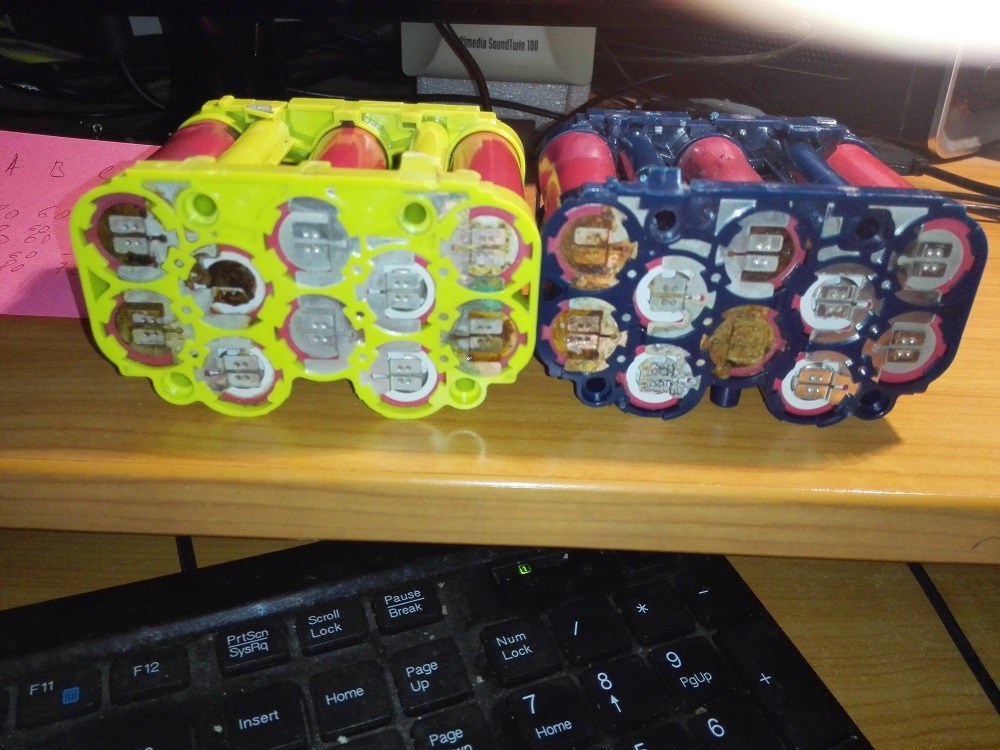
the last photo confirmed my assumption – that the saw remained in the rain and left not one but several batteries
batteries are some high power ….:
https://www.aliexpress.com/wholesale?catId=0&initiative_id=SB_20180308095944&SearchText=LGDBHE21865+High+Drain


HI,
do not you guys have any idea how to test the battery quickly? What sampling (A or W)
I think there will be a difference in discharge time with a new and older battery
did I attempt to connect several halogen 12 V car lighters (3 + 3 = 330W)?