
Table of Contents
- Introduction
- Start with What You’ll Haul
- The CE Platform: Frame, Axles and Deck
- Ramps: Fold-Up vs. Slide-In
- Why a Dovetail Matters
- Split Heavy-Duty Gates
- Go a Little Longer
- Tie-Downs, Rails and Stabilizer Jacks
- Buggy Haulers and Super-Wides
- Final Thoughts
- FAQ
Introduction
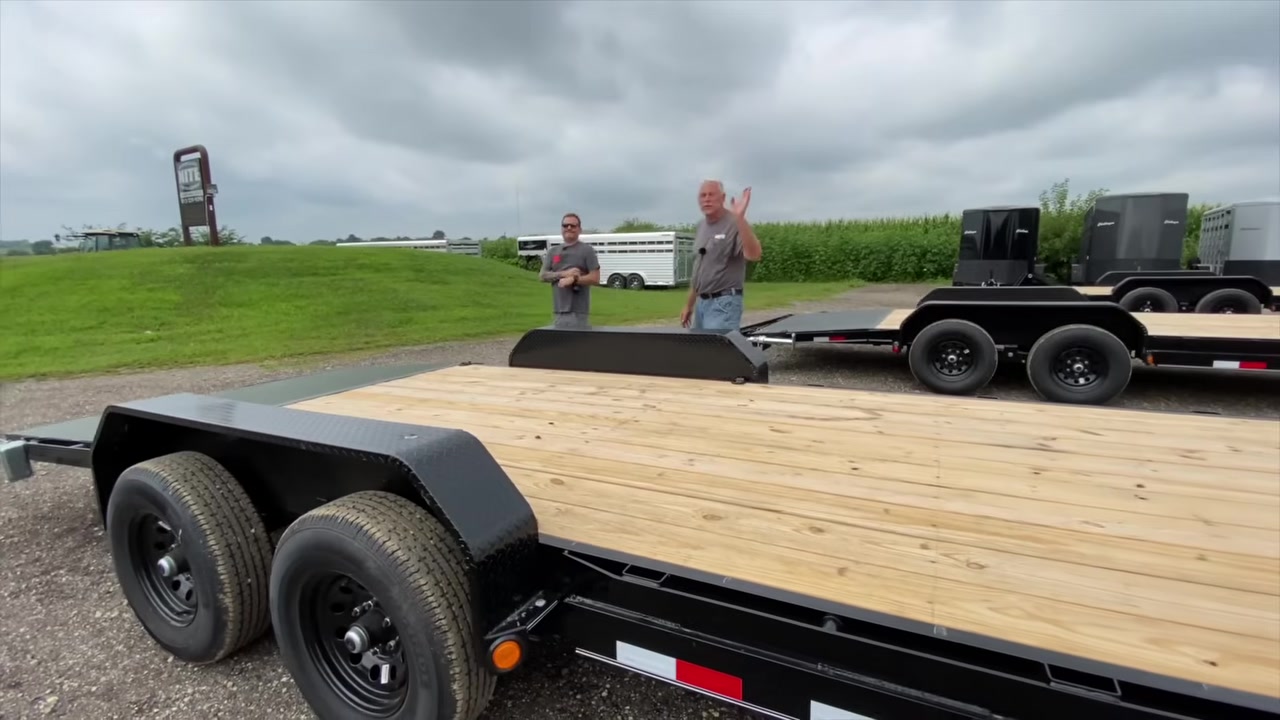
Buying a trailer is easy. Buying the right trailer takes some thought. Dan was shopping for something to haul vehicles, a tractor and eventually zero-turn mowers, so he visited NITE Equipment in Pecatonica, Illinois — just west of Rockford — and walked the lot with Rick, who Dan half-jokingly calls the trailer master. Together they went through several PJ Trailers in the CE equipment-trailer family and talked through what actually matters before you spend the money.
This wasn’t a first visit. Tools in Action has had a long relationship with NITE and with PJ. The last open PJ they ran had lasted a long time, and they liked the build quality enough to come back. Dan had already spent time with a PJ utility trailer and, later, the orange PJ dump trailer. This time he showed up wanting a car-hauling trailer — his words — and he had a 20-footer with ramps already in mind. After walking the options, he left with a 22-footer, and not even the ramps he first thought he wanted.
The old trailer was about seven years old and still a good one. A practical reason to look at a new one: trailer tires typically want replacing every five to seven years, and they were looking at five tires plus the hubs. They also didn’t want to keep fighting to keep air in the tires. The point of the visit wasn’t to rubber-stamp a model Dan had already picked on a website. It was to match a trailer to the work.
Start with What You’ll Haul
Rick’s first point, and he comes back to it all morning: they work from your application, not the other way around. NITE doesn’t just try to sell a trailer. Before anyone talks model numbers, they want to know what you’ll load on it — how long and heavy it is, whether it has small wheels or low ground clearance, and whether you’ll also haul cargo, pallets or something that hangs off the back.
Dan had already been on NITE’s live inventory site, which they try to keep fresh within 24 to 48 hours, and had picked out a trailer. Rick didn’t have that style in the length Dan needed, so Dan looked at another one. From that little bit of information, Rick staged eight trailers that morning — all in the same PJ family — so they could walk the differences in person. That’s a better way to shop than falling in love with one photo online and hoping it fits the job.
If your list looks like Dan’s — vehicles, a tractor, and later zero-turns — those uses pull you in slightly different directions. A compact tractor is happy on basic fold-up ramps and doesn’t have to have a dovetail. A modern car, a race car or a mower with small wheels will care a lot about ramp style, rung spacing and how gradual the climb is onto the deck. Get the job straight first, then pick the options.
The CE Platform: Frame, Axles and Deck
Most of what they walked that morning was the PJ model CE, the five-inch channel equipment trailer. People do haul cars on it, but it comes in a lot of configurations. The basic model is consistent underneath the options.
The tongue and the bed frame are five-inch channel. The standard cross members under the deck are three-inch channel on 16-inch centers. The standard trailer has a wood deck, bolt-on fenders, all LED lights and radial tires, and it is equipped with 5,200-pound-rated axles. The first unit they stopped at was set up to haul a small skid steer or tractors, with 83 inches between the fenders.
A few other details are easy to skip in a lot photo and worth asking about in person. A spare-tire mount is standard on these, and Rick pointed out that it isn’t welded on the side where it would get in the way of a forklift. On one of the CE units they looked at, a toolbox was optional, the trailer had a 7,000-pound jack, and a winch mounting plate had been added at the front of the bed in case you want to mount a winch. None of that changes the underlying CE platform. It just shows how many ways the same trailer can be ordered.
Ramps: Fold-Up vs. Slide-In
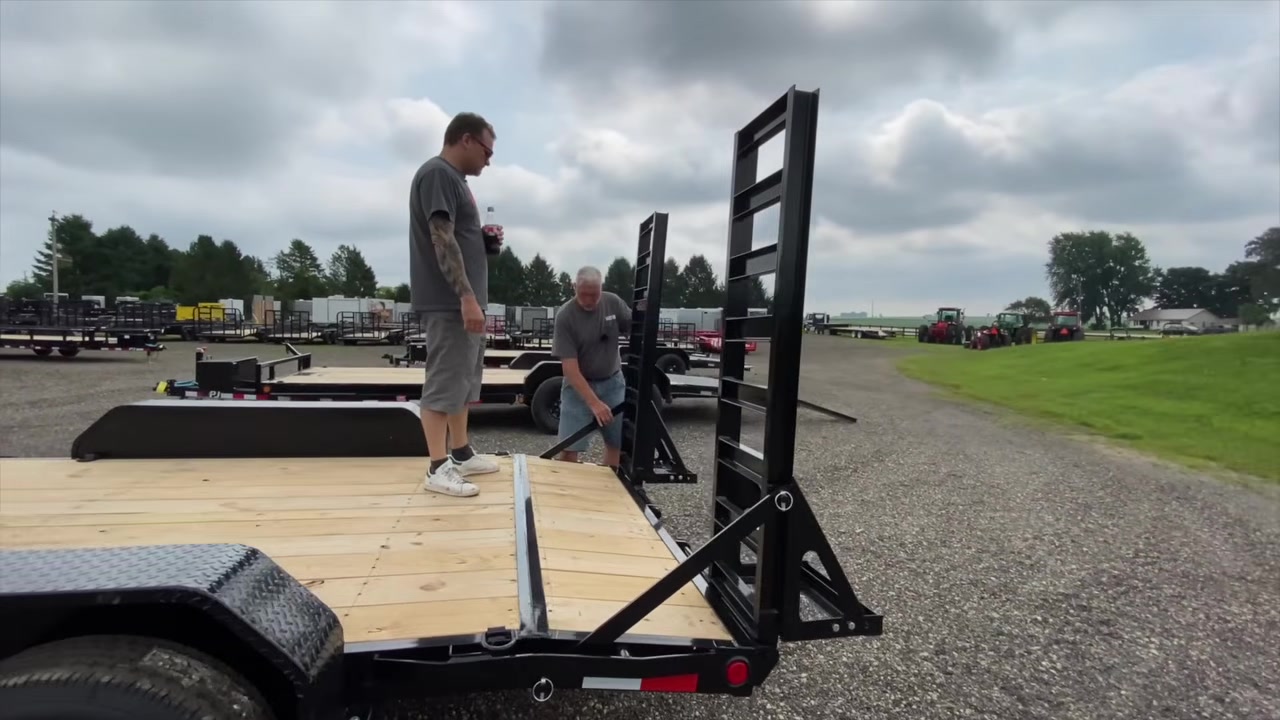
The first trailer had the very basic spring-loaded fold-up ramps. Their real advantages, Rick said, are that they’re durable, easy to handle and cost-effective — they don’t cost very much. He lifted one, propped it and showed how light they feel with the springs. The downside: they don’t come off or remove very easily, so they get in the way of a load that overhangs the back. If you had something longer than the deck, you wouldn’t be able to fit it.
Those ramps also aren’t what Rick would call multi-purpose. The rungs are three-inch channel, spaced quite a bit apart, so a small-wheeled mower would not go up them as well. They’re more for hauling a compact tractor. You could load a car, but once Dan mentioned he’d eventually be hauling zero-turns too, Rick’s take was that this setup may not be the best.
The next CE looked quite a bit different in back, but it was the same model. Instead of fold-up ramps it had slide-in ramps and a longer dovetail. Slide-in ramps store in pockets at the rear of the deck. Standard storage on this style is from the side, but because durable ramps are pretty heavy, Rick’s preference is to store them from the rear. You pull them straight back and lift them straight up, instead of carrying the weight from the side, and you can separate them where you want them.
If you’ll haul a lot of mowers, those ramps can be covered with expanded metal and still fit up in the same pockets. That gives you something durable enough for tractors, cars and trucks, with a surface small wheels can roll up. It is an option from PJ, and it isn’t only a build-time choice: if you bought the trailer today and later decided you needed those ramps, Rick said you just order the ramps and they still fit.
Why a Dovetail Matters
A dovetail is the angled section at the back of the deck. It takes out that sharp point of transition from a ramp to a straight deck and gives you a more gradual entry. You would want one for loading cars, or really anything on wheels. You don’t have to have a dovetail just to load a tractor.
The first CE had a two-foot dovetail — the small one. The slide-in unit had a four-foot dovetail, which Rick said is popular with car and truck dealerships that need to haul bigger trucks, and with modern cars that sit lower to the ground. Pair that with a five-foot ramp and you have a nine-foot transition, versus a seven-foot transition on the two-foot dovetail with the same five-foot ramp. Stand off to the side and the difference is obvious. If you’re hauling a race car or anything else that sits very low, you have to be careful, and you want more of a transition like the four-foot dovetail. Everyday modern cars are lower than they used to be, too.
On the four-foot dovetail trailer, the very back of the deck was steel, not wood. That’s not a styling choice. The ramp holders in the back — the ramp pockets — would sit lower if the wood ran at full thickness all the way to the rear, and those pockets could catch on something on uneven ground. The steel lets them raise the pockets about an inch and a half.
There’s only so much you can figure out on paper. If someone has a special, expensive car they rarely take out, NITE will sometimes let them take a trailer home and test-load it. Rick mentioned that Jason had done exactly that with a customer two weeks before, test-loading a fancy old Corvette. For a dedicated use like that, he said, you just about have to test it. You can’t always draw it out and do it mathematically.
Split Heavy-Duty Gates
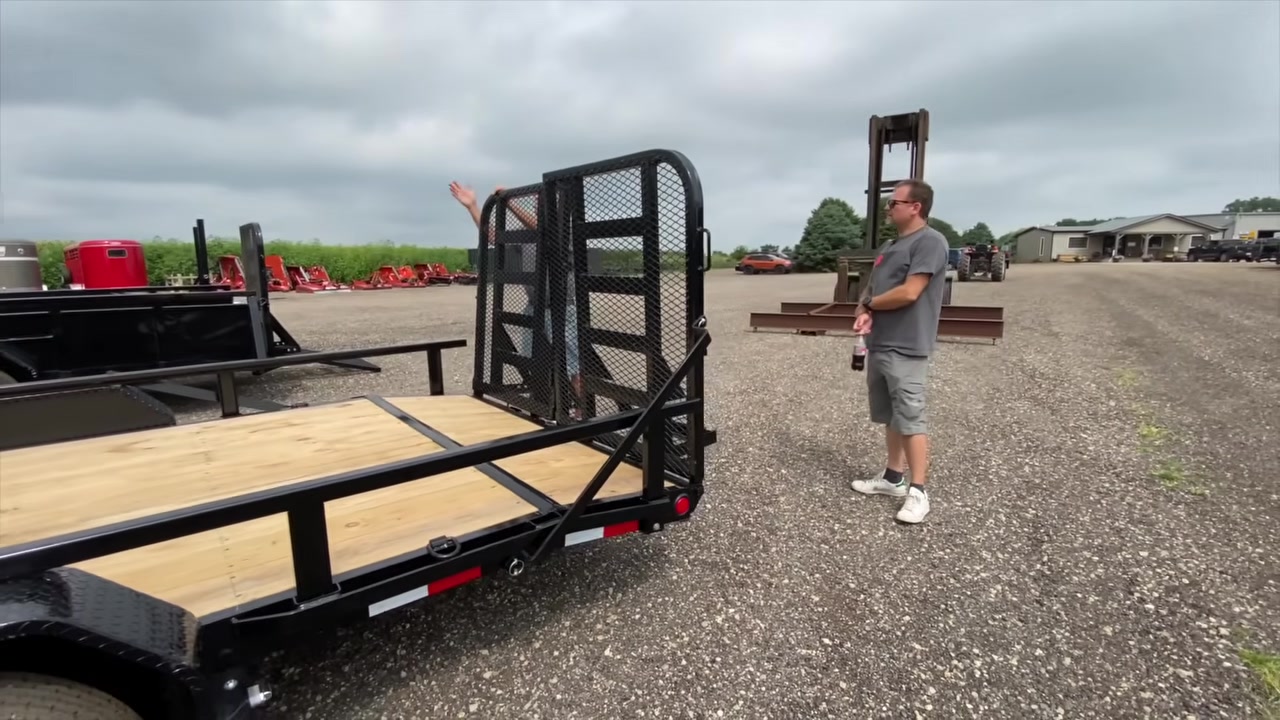
A third CE on the lot used a two-foot dovetail with a split heavy-duty gate — the style Dan already knew from the older trailer. It’s a multi-purpose gate, but the gate itself is only four feet, so with the two-foot dovetail you have a six-foot approach. That’s less than the seven-foot and nine-foot transitions on the other two trailers. It works fine for tractors and a small skid steer. For cars that sit really low to the ground, you don’t quite have the same approach.
Where this setup shines is a crew that loads and unloads all day. Rick’s example was a mowing crew loading three 2,500-pound zero-turn mowers, working seven days a week, on and off the trailer maybe 15 times a day. You have a full-width ramp, you’re not lining up with anything, and you can zip on and zip off. It’s easy to lift and lower. Landscapers gravitate to this option, and you can still haul a car nicely if the approach is enough for that car.
On the lot that day, Rick put the premium for this gate over the standard fold-ups at maybe $175. That was his number in the video, not a current price. Compared with removable side rails, which he had at about $350, the gate is a lot of extra steel for less money than you’d think.
If you’re a landscaper hauling palleted paving bricks or shrubs, you can take the sides off, keep the gate on the back, and approach from the side with a forklift. Rick’s view is that you don’t really want to drive a forklift in from the back anyway — you don’t want all that weight there. From the side, you set a pallet, use a block and push it forward, then set the next one. It’s a more natural way to load that kind of cargo.
Go a Little Longer
Rick said he can’t begin to tell you how many times people come back after buying a trailer and say they wished they’d bought about two feet longer, or six inches wider. He rolled out the same basic CE in 20-foot and 22-foot lengths just to make that point. The 20-footer was the length Dan had originally asked for.
On that lot, the only price difference Rick quoted was $75 for two more feet on the back end. Again, that was the number that day in the video, not a price to shop to now. Dan wondered whether the extra length would make the trailer harder to maneuver. Rick’s take, talking to an experienced trailer user, was that you won’t hardly tell the difference between 20 and 22 feet. What you will notice is storage: if you’re putting it in a shed or a garage, it may not fit, and it will take up more space. Make sure the longer trailer still fits where you keep it. The extra couple of feet is there for the load you weren’t even planning on hauling today.
Tie-Downs, Rails and Stabilizer Jacks
Dan wanted plenty of tie-down points. Stake pockets are standard on the CE. A rub rail is an add-on. The first trailer also had six D-rings in addition to that. The rub rail was a must for Dan. He’d looked at another brand that he otherwise liked and noticed it only had about three D-rings and no rails. With a rub rail, you can hook a strap in a lot more places.
The stands at the back do more than hold the ramps. They are adjustable ramp stands, and they telescope in and out so you can set them once the trailer is at the level you’ll tow it. If you’re using a lighter-weight truck, a heavy load rolling up the ramps will often lift the back of the tow vehicle off the ground. Those stands are used as stabilizer jacks to keep that from happening.
Removable side rails are another option if you haul things on wheels some days and cargo on others. On the unit they walked, the side rail pins on in front and bolts on in three places, so you can take the rails off to load pallets from the side with a forklift and put them back on when you want the sides. Rick had that option at about $350 that day.
PJ also offers a more built-in landscape version of the same CE: 22-inch solid sides with a two-by-two-inch square top rail, a landscape toolbox across the front, a side-load ramp, and the same split heavy-duty ramps at the back. D-rings are added on the inside so you can still strap machines down — Rick was clear that safety still calls for that. What landscapers like is not having to strap every loose thing the way you would on a flat deck. For yard cleanups, especially if they don’t have a dump trailer yet, they want those sides so they can load barrels of debris, or load material in loose. Sometimes they’ll even stand plywood along the sides to make them taller.
Buggy Haulers and Super-Wides
Rick also pulled a couple of wider cousins out of the same five-inch-channel family so Dan wouldn’t miss them. The first is what PJ calls a buggy hauler, model B5. It still has the five-inch channel frame and five-inch channel tongue, but the deck is extra wide in front of and behind the fenders, the way a gooseneck flatbed is, and it has quarter-inch-thick drive-over fenders. If you’re hauling a rock buggy with big balloon tires and you want to stay low to the ground for loading, that’s the idea.
It isn’t a wider trailer in the sense that matters on the road. Outside tire to outside tire, Rick said, it’s the same width as the others. You just have more deck around the fenders. It costs more because there’s more material in it, and some people don’t want to be that wide all the way down the road. That’s why not every CE is built this way.
The bigger version is the Super Wide. It’s set up the same way, with the extra-wide deck and heavy fenders, but it is equipped with 7,000-pound axles. Between the fenders, Rick had these at about 82 and a half inches. The back ramps slide left and right so you can line them up with the tires on the machine you’re loading — even without being freshly lubed, the ones on the lot still slid over when he showed it.
By the end of the walk, Dan was a little overwhelmed, which is a normal place to land: sides or no sides, which ramps, how much trailer is enough, and what it all does to the price. Rick’s process at that point is to leave the customer alone for a minute — grab a bottle of water or a soda, let them dwell on it, and take the next few questions when they’re ready. It’s a good start, he said, to coming up with the right trailer for that customer’s particular applications. Then you talk price inside, not out on the lot in front of eight trailers.
Final Thoughts
Know your loads, pick ramps and a dovetail that suit them, buy a little more length than you think you need, and don’t skimp on tie-downs. The CE family they walked is a five-inch channel equipment trailer with 5,200-pound-rated axles, and the “right” one is less a single model than a set of options: fold-up ramps or slide-ins or a split gate, a two-foot or four-foot dovetail, removable rails or solid sides, and, if you need the deck width, a buggy hauler or Super Wide.
Dan went in sure he wanted a 20-footer with ramps. He left with a 22-footer and a different ramp setup than he’d pictured. That’s the value of walking the lot with someone who will educate you instead of just selling you a trailer. For towing gear, see our look at the Weigh Safe hitch and the MaxxTow hitch-mounted crane, plus more in our buyer’s guides and PJ Trailers coverage.
FAQ
What should I decide before buying an equipment trailer?
What you’ll haul: its length, weight, wheel size and ground clearance. That drives the ramp, dovetail and length choices.
What’s the advantage of a dovetail?
It reduces the angle where the ramp meets the deck, which helps low vehicles load without scraping. A four-foot dovetail with a five-foot ramp gives a nine-foot transition; a two-foot dovetail with the same ramp gives seven feet.
Fold-up or slide-in ramps?
Fold-up ramps are durable and inexpensive but don’t remove easily, and widely spaced rungs aren’t ideal for small mower wheels. Slide-in ramps store at the rear and come out of the way when you don’t need them. Rear storage is easier than side storage because the ramps are heavy. A split heavy-duty gate is a third option if you want a full-width ramp for frequent loading.
Should I buy a longer trailer?
The dealer said many buyers wish they’d gone a couple of feet longer, or even six inches wider, and that the extra length barely affects maneuverability for experienced drivers. Just make sure it still fits where you store it.
What are the stands at the back of the trailer for?
They stabilize the trailer so a heavy load going up the ramps doesn’t lift the back of the tow vehicle. The stands are adjustable and telescope to match the height you’ll tow at.
What is the PJ CE equipment trailer?
It’s PJ’s five-inch channel equipment trailer. The units they walked had a five-inch channel tongue and bed frame, three-inch channel cross members on 16-inch centers, a wood deck, bolt-on fenders, LED lights, radial tires and 5,200-pound-rated axles, with 83 inches between the fenders on the first example.
Can I add expanded-metal ramps later?
Yes. Rick said expanded-metal covers are a PJ option, they still fit the slide-in pockets, and you can order those ramps after you already have the trailer.
What’s the difference between a buggy hauler and a Super Wide?
Both stay in the five-inch channel family and add an extra-wide deck plus drive-over fenders, without changing overall width from outside tire to outside tire. The B5 buggy hauler is the first of those. The Super Wide is the bigger version, with 7,000-pound axles and ramps that slide side to side to line up with a machine’s tires.
Leave a Reply